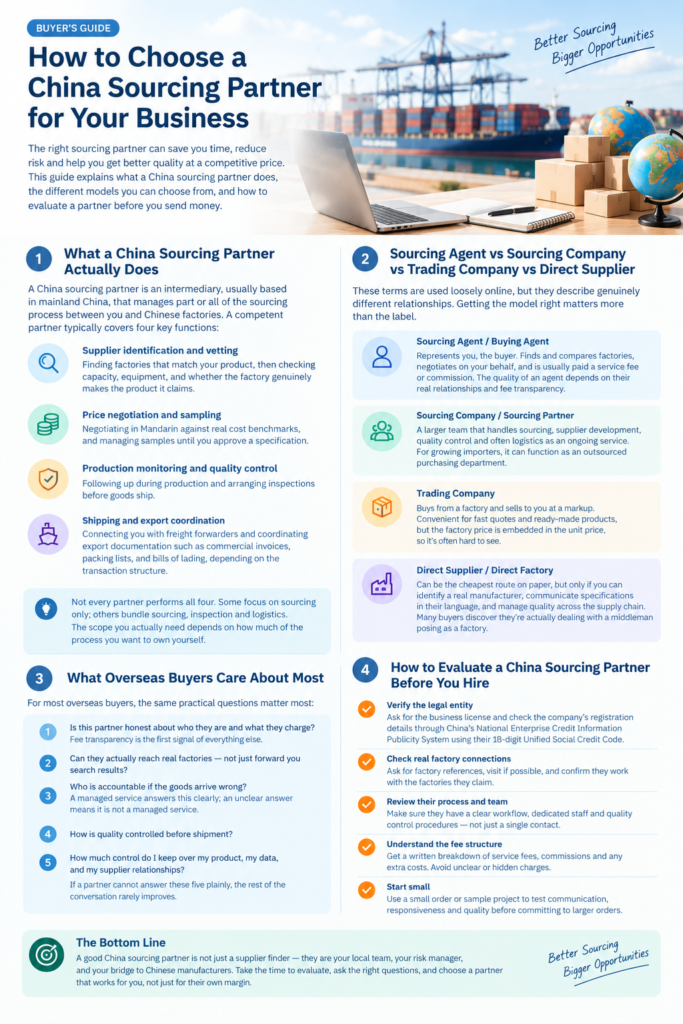
If you are buying from China for the first time — or a supplier relationship has quietly started costing you more than it saves — the partner you choose to manage that sourcing is one of the highest-leverage decisions you will make. The wrong partner adds hidden cost, masks quality problems, and leaves your first large order exposed. The right one works as an extension of your own purchasing team.
This guide is written for B2B buyers, importers, and growing businesses in the US and other markets. It explains what a China sourcing partner actually does, how the different sourcing models compare, how to verify a partner before you send money, and the red flags that should end a conversation early. It is deliberately practical and specific throughout.
What a China sourcing partner actually does
A China sourcing partner is an intermediary, usually based in mainland China, that manages part or all of the sourcing process between you and Chinese factories. The scope varies widely, but a competent partner typically covers four functions:
- Supplier identification and vetting. Finding factories that match your product, then checking capacity, equipment, and whether the factory genuinely makes the product it claims to.
- Price negotiation and sampling. Negotiating in Mandarin against real cost benchmarks, and managing samples until you approve a specification.
- Production monitoring and quality control. Following up during production and arranging inspections before goods ship.
- Shipping and export coordination. Connecting you with a freight forwarder and preparing export documents such as the commercial invoice, packing list, and bill of lading.
Not every partner performs all four. Some focus on sourcing only; others bundle sourcing, inspection, and logistics. The scope you actually need depends on how much of the process you want to own yourself.
Sourcing agent vs sourcing company vs trading company vs direct supplier
These terms are used loosely online, but they describe genuinely different relationships. Getting the model right matters more than the label.
Sourcing agent / buying agent
An agent represents you, the buyer. They find and compare factories, negotiate on your behalf, and are usually paid a service fee or commission. In principle, an agent’s incentive is to get you the best factory price and quality — not to sell you a specific product at a markup. The quality of an agent depends heavily on their real relationships in China’s manufacturing clusters and how transparent they are about their fees.
Sourcing company / sourcing partner
A sourcing company is usually a larger version of an agent: a team that manages sourcing, supplier development, quality control, and often logistics as an ongoing service. For growing importers, a sourcing company can function as an outsourced purchasing department. The key question is the same one you would ask an agent: do they work for you, or do they resell?
Trading company
A trading company buys from a factory and sells to you at a markup. That can be convenient — fast quotes, catalogs of ready-made products, and export experience — but the factory price is embedded in the unit price, so it is often hard to see. A trading company can be a perfectly good fit for simple, standard products or small test orders; it is usually the wrong fit when you want factory-level pricing and direct control over production.
Direct supplier / direct factory
Working directly with a factory can be the cheapest route on paper, but only if you can genuinely identify a real manufacturer, communicate specifications in their language, and manage quality across a long supply chain from another continent. Many buyers who attempt “direct” sourcing discover they have actually been dealing with a middleman who presents as a factory — which is exactly the problem a good sourcing partner is meant to prevent.
What overseas buyers care about most
Across sourcing guides, forums, and supplier-vetting checklists, the same buyer concerns come up again and again:
1. Is this partner honest about who they are and what they charge? Fee transparency is the first signal of everything else.
2. Can they actually reach real factories — not just forward you search results?
3. Who is accountable if the goods arrive wrong? A managed service answers this clearly; an unclear answer means it is not a managed service.
4. How is quality controlled before shipment?
5. How much control do I keep over my product, my data, and my supplier relationships?
If a partner cannot answer these five plainly, the rest of the conversation rarely improves.
How to evaluate a China sourcing partner before you hire
1. Verify the legal entity
Ask for the business license and check the company’s registration details. In China, companies can be looked up through the official National Enterprise Credit Information Publicity System using their 18-digit Unified Social Credit Code. Confirm the company name on the license matches the name on the bank account you are asked to pay — a mismatch is a serious warning sign.
2. Confirm they can reach factories
Ask how they identify factories beyond online marketplaces. The most valuable factories in clusters such as Guangdong, Zhejiang, and Fujian often have limited English-language presence online, so a partner who can only send you platform listings is limited. A partner who visits factories and verifies production floors directly is far more useful.
3. Ask exactly how quality is controlled
Ask what happens between “order placed” and “goods shipped.” A professional answer includes a defined specification, an approved sample, and an inspection before shipment — often against an agreed defect limit. Vague answers here are the most expensive kind of vague.
4. Understand the fee structure
Ask how they are paid, what is included, and what is billed separately. The two common models are a commission on order value and a flat or project fee, sometimes combined with a minimum charge on very small orders. Neither is inherently better; both should be stated up front. Be cautious of “free” sourcing — the cost is usually built into the product price, which reduces your visibility.
5. Check references and communication
Ask for references from buyers with verifiable orders, and test responsiveness during the evaluation itself. How a partner communicates before you have paid is usually the best predictor of how they will communicate once a deposit is on the table.
Questions to ask before you commit
1. Who do you represent — me, or the factory?
2. How do you identify and vet factories, and can I see evidence of a factory visit?
3. How are your fees structured, and what is not included?
4. Will you share factory quotes and contacts, or hold them?
5. How do you handle samples and specification approval?
6. What quality checks happen before shipment, and who performs them?
7. What happens if the goods are defective or not to specification?
8. Which Incoterms do you work with, and who arranges freight?
9. Who prepares export documentation such as the invoice and packing list?
10. Which languages do you work in, and who will be my day-to-day contact?
11. How do you handle my product designs and data?
12. What is your process for a first, smaller trial order?
Common risks and red flags
Sourcing from China carries real, well-documented risks. Most are avoidable with basic discipline:
- Middlemen presenting as factories. A suspiciously wide catalog of unrelated products, evasive answers about the production address, or refusal to provide a verifiable business license are classic signals.
- Bait-and-switch quality. A perfect sample followed by a lower-quality bulk run. Locking down an approved sample — and inspecting against it — is the countermeasure.
- Payment risk. Fake suppliers who disappear after payment, or email interception that changes bank details. Verify bank details by a second channel, and never pay 100% up front.
- Hidden cost in a “cheap” quote. A low unit price with a large embedded markup, or undisclosed inspection, consolidation, and freight fees.
- No accountability. If “what happens when the goods are wrong?” is answered by pointing back at the factory, you do not have a managed service.
How sourcing partners are typically paid
Sourcing partners are generally paid in one of a few ways: a percentage commission on the order value, a flat or project fee for a defined scope, or an hourly / day rate for consulting or in-market visits. Commission percentages and flat fees vary widely by product category, order size, and scope, and change over time, so treat any single number you read online — including ranges quoted by competing providers — as a starting point to verify, not a fact. What matters most is whether the structure is disclosed before you commit and whether the total cost is competitive once product price, inspection, and freight are combined.
A practical first-order workflow
For a first order with a new partner, a cautious sequence protects both sides:
1. Define the specification. Product, materials, dimensions, packaging, and defect limits, written down.
2. Approve a sample. Do not approve bulk production from a photo.
3. Pay a deposit, not the total. A staged structure (for example, a deposit to start production with the balance against shipment or inspection) keeps leverage in your hands.
4. Inspect before shipment. Arrange an inspection against the approved sample and specification.
5. Control the documents. Check the commercial invoice, packing list, and bill of lading before release.
6. Debrief and scale. Only increase order size once a small order has performed.
Do you need a sourcing partner at all?
Not always. If you are buying simple, standard products in small quantities from a reputable marketplace with buyer protection, you may not need one. A sourcing partner tends to earn its cost when you are developing a custom or private-label product, ordering at a volume where defects are expensive, needing supplier verification, or when the time cost of managing factories yourself outweighs the fee. The honest test is whether the fee is smaller than the cost of the mistakes it prevents.
How we can help
We help businesses source products from China and can connect buyers with suitable suppliers and vetted service providers based on their requirements. Where a service involves third parties — for example inspections, testing, or freight — we will tell you clearly which parts are handled by us and which are arranged through verified partners in our network. If you are evaluating China sourcing support and want a straight answer about scope and cost, get in touch and we will tell you plainly what we can and cannot do for your product.
Frequently asked questions
What is the difference between a China sourcing agent and a trading company? A sourcing agent represents you and is typically paid a fee or commission, working to get you the best factory price and quality. A trading company buys from the factory and resells to you at a markup, so the factory cost is embedded in the unit price. Agents suit buyers who want transparency and control; trading companies suit buyers who want speed and ready-made products.
How much does a China sourcing partner cost? It depends on structure and scope. Partners are commonly paid a commission on order value, a flat or project fee, or an hourly/day rate. Percentages and flat fees vary by category, order size, and scope, so confirm the structure in writing before you commit and compare it against the total landed cost — not just the unit price.
How do I verify a China supplier or sourcing partner is legitimate? Request the business license and check the company’s registration via China’s official National Enterprise Credit Information Publicity System using its Unified Social Credit Code, confirm the license name matches the bank account name, ask for evidence of factory visits, and request references with verifiable orders.
What happens if the goods arrive defective? A managed sourcing partner should define quality standards before production, inspect against an approved sample before shipment, and be clear about remedies if goods fail to meet specification. If the answer to “what happens if the goods are wrong?” is unclear, treat that as a reason not to proceed.
Can I work directly with a factory instead? Yes, but direct sourcing only saves money if you can genuinely identify a real manufacturer, communicate specifications in Mandarin, and manage production and quality remotely. Many buyers who believe they are buying direct are actually dealing with a middleman presenting as a factory.
Are sourcing agents worth it for small buyers? Often, yes — but it depends on the order. Sourcing support tends to pay for itself when you are developing custom or private-label products, ordering at a volume where defects are costly, or need supplier verification. For simple, low-value marketplace purchases with buyer protection, it may not be necessary.
What is the safest way to pay a Chinese supplier? Avoid 100% upfront payment. Use a staged structure — a deposit to begin production with the balance against shipment or a passed inspection — and verify bank details through a second communication channel to guard against email interception scams. Buyer-protection and escrow options exist on some platforms for smaller orders.
Which Incoterm is best for a first-time importer? Many first-time buyers find FOB (Free on Board) easier to manage than EXW, because the supplier handles transport to the port and export clearance, and your responsibility begins once the goods are loaded. The best choice depends on your experience and who you want to manage freight.